
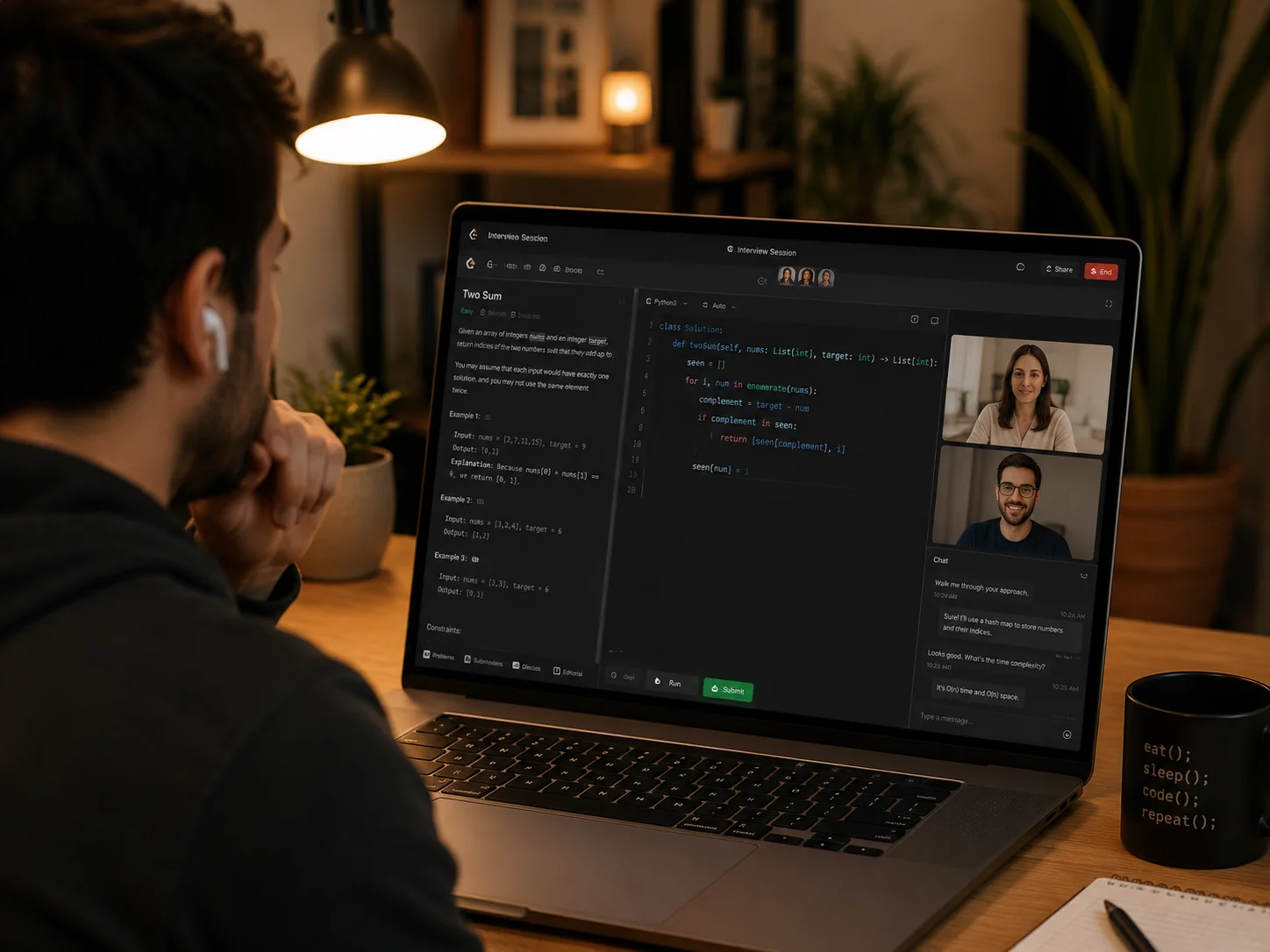
Most developers practice technical interviews the same way: they open LeetCode, solve problems alone with no time pressure, check the solution when they get stuck, and feel okay about their progress. Then they walk into an interview, freeze on a medium-difficulty problem they have solved before, and leave confused about what went wrong.
The problem is not talent. The problem is that they practiced the wrong thing.
Solving problems in silence with no time limit and infinite hints is completely different from explaining your thinking out loud while a stranger watches you struggle under a 45-minute timer. One is a skill. The other is a different skill. You need to practice both — but most people only practice the first.
This guide gives you the deliberate practice framework that engineers use to go from "I know the concepts but freeze in interviews" to "I interview well consistently."
Why Technical Interviews Are Hard (The Real Reason)
The conventional wisdom is that technical interviews are hard because the problems are hard. That is only partly true.
Technical interviews are hard because they require you to perform three cognitive tasks simultaneously that are never required simultaneously anywhere else:
- Understand and decompose an ambiguous problem while thinking out loud
- Remember and apply algorithmic patterns while explaining your thinking
- Write syntactically correct code while maintaining a conversation
Add the psychological pressure of being evaluated by someone whose judgment determines your financial future, and you understand why even strong engineers blank on problems they have solved dozens of times.
The skill you are actually developing through technical interview practice is not "knowing algorithms." It is performing under pressure while communicating clearly. That is a trainable skill. It just requires the right practice conditions.
The Four Components of a Strong Technical Interview
Before you can practice deliberately, you need to know what you are actually being evaluated on. Interviewers at most companies score candidates on these four dimensions:
1. Problem Solving Ability Can you break down a problem you have not seen before? Can you identify the right approach? Can you recover when your first approach is wrong? This is the baseline — you need to pass this to get hired.
2. Technical Knowledge Do you know the right data structures and algorithms for the problem? Can you analyze time and space complexity? Can you discuss trade-offs between approaches?
3. Coding Skills Is your code clean, readable, and correct? Do you use meaningful variable names? Do you handle edge cases? Do you test your solution?
4. Communication This is the most underweighted component in self-preparation. Do you think out loud? Do you ask clarifying questions? Do you explain your reasoning before coding? Do you listen to hints?
Most candidates fail communication, not problem-solving. They go quiet and code. Interviewers hate this — they cannot evaluate a candidate who does not talk.
The Deliberate Practice Framework
Deliberate practice means practicing under conditions that specifically target your weaknesses with immediate feedback. Random LeetCode grinding is not deliberate practice. Here is the framework that is:
Phase 1: Pattern Recognition (Weeks 1–3)
Before you can apply algorithmic patterns, you need to recognize them. There are approximately 15 core patterns that cover 90% of technical interview problems:
- Two Pointers — sorted arrays, linked list problems
- Sliding Window — subarray/substring problems with a condition
- Fast & Slow Pointers — cycle detection in linked lists
- Merge Intervals — overlapping intervals, meeting rooms
- Cyclic Sort — problems with numbers in range [1, n]
- In-Place Reversal of a Linked List — reverse sub-list patterns
- Tree BFS — level-order traversal, connect level nodes
- Tree DFS — path sum, diameter, subpaths
- Two Heaps — median of a stream, scheduling
- Subsets — permutations, combinations, subsets
- Binary Search — sorted arrays, rotated arrays, search space
- Top K Elements — k largest/smallest
- K-way Merge — merge k sorted lists
- Topological Sort — task scheduling, course prerequisites
- Dynamic Programming — overlapping subproblems, optimal substructure
For each pattern, study 3 problems that exemplify it. You are not grinding — you are learning to identify the trigger conditions that tell you "this is a sliding window problem."
Phase 2: Timed Solo Practice (Weeks 4–6)
With pattern recognition built, move to timed practice under realistic conditions. The rules:
- Set a timer for 25 minutes
- No hints, no solutions, no Google during the timer
- Read the problem, think for 5 minutes before coding anything
- Code your solution
- When the timer ends, spend 10 minutes analyzing: what did you get right, what did you struggle with, what would you do differently
The 25-minute timer matters. It creates a pressure that forces you to make decisions and move forward. Without it, you can spend 45 minutes on a "thinking" phase and never build the real skill.
After the 10-minute analysis, look at the optimal solution and understand why it is better. Do not move to the next problem until you could reproduce the optimal solution from memory.
Phase 3: Mock Interviews With a Partner (Weeks 7–12)
This is the most important phase and the one most developers skip entirely.
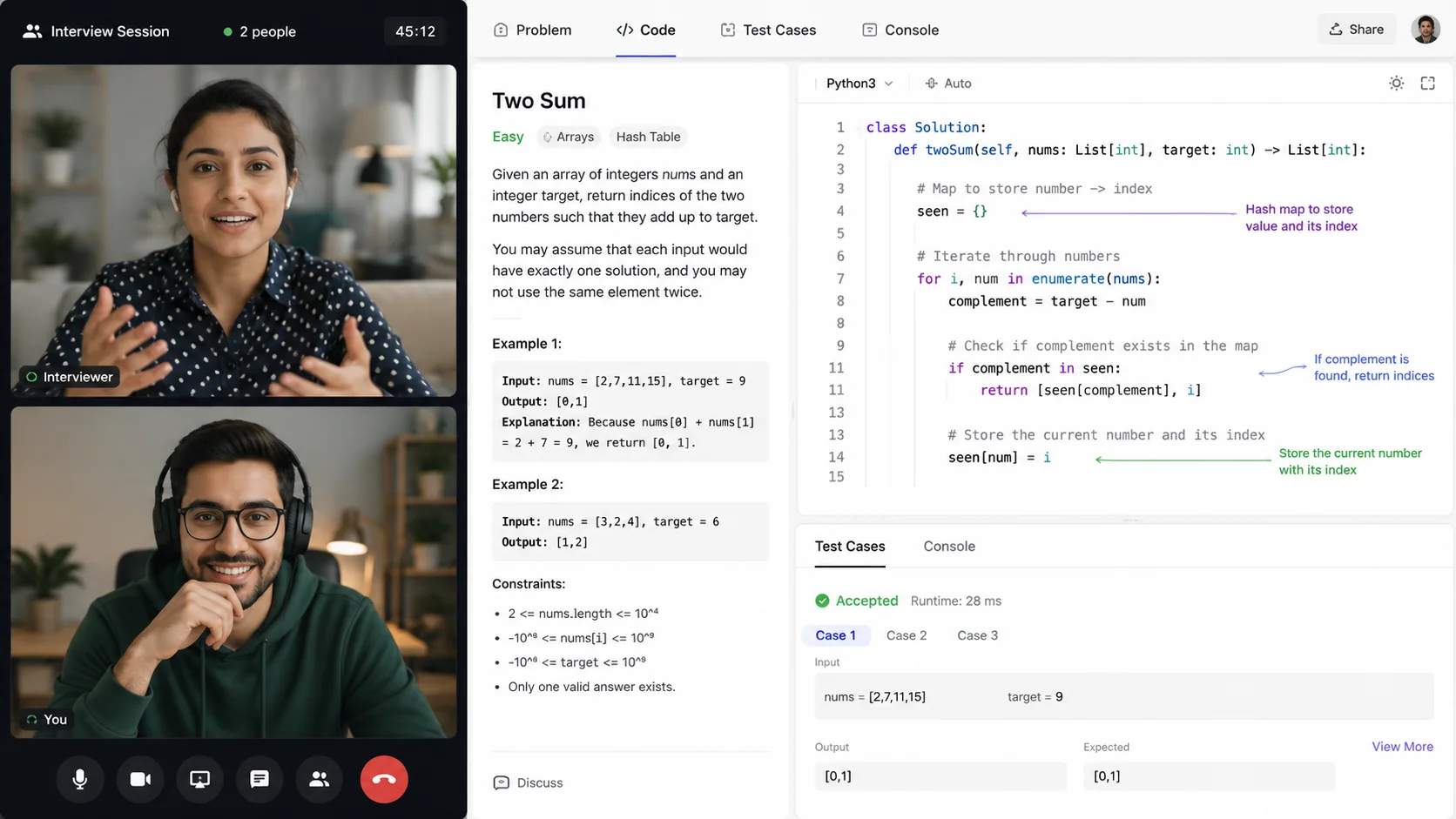
Mock interviews with a real person are irreplaceable because they train the communication and pressure components that solo practice cannot. The first time you do a mock interview, you will be surprised how different it feels from solving problems alone. That surprise is information — your brain is encountering a situation it has not been trained for.
The protocol:
- Find a practice partner — a classmate, a colleague, someone from a study group, or use the BuildrHQ Mock Interview platform
- Interviewer selects a problem without showing it to the candidate
- Candidate gets 45 minutes, timed
- Candidate must think out loud throughout — no silent periods longer than 30 seconds
- Interviewer can give hints (but notes when they do)
- After the timer: 10-minute structured debrief
The debrief framework:
- What did the candidate do well?
- When did they get stuck, and how did they recover?
- Was the communication clear throughout?
- What did the interviewer learn about how the candidate thinks?
- What should the candidate work on next?
Two mock interviews per week for six weeks. Your interviewing performance will be unrecognizable by the end.
The Communication Protocol
The biggest immediate improvement most candidates can make is following a communication protocol during problem solving. Here it is:
Step 1: Restate the problem (1–2 minutes) "So to make sure I understand — I am given an array of integers and I need to find the maximum sum subarray. The array can have negative numbers. I should return just the sum, not the indices. Is that right?"
This confirms you understood the problem and gives the interviewer a chance to correct you early. It also buys you thinking time.
Step 2: Ask clarifying questions (2–3 minutes) "Can the array be empty? What should I return in that case? Is the input sorted? Can I modify the input array? What is the expected size — do I need to worry about n being very large?"
Not all questions matter for every problem, but asking them signals seniority and professionalism. Interviewers give credit for identifying and addressing edge cases.
Step 3: State your approach before coding (2–3 minutes) "I think the brute force here is O(n²) — check every pair of indices. But I think I can do better. I am thinking dynamic programming. At each index, the maximum subarray ending here is either the current element alone or the current element plus the best subarray ending at the previous index. This gives me O(n) time and O(1) space. Does that approach make sense before I code it?"
Wait for the interviewer to confirm. If they say "can you think of a different approach?" that is a hint that something is wrong with your plan. Do not start coding without buy-in.
Step 4: Code with commentary As you write code, narrate what you are doing: "I will initialize max_sum and current_sum to the first element. Then for each subsequent element, I will take the max of the element alone or the element plus current_sum..."
This makes your thought process visible. Even if you make a mistake, an interviewer who can follow your thinking can evaluate you accurately and give targeted hints.
Step 5: Test your solution After writing the code, walk through it with a specific example. "Let me trace through with [−2, 1, −3, 4, −1, 2, 1, −5, 4]. At index 0: current_sum = −2, max_sum = −2. At index 1: current_sum = max(1, 1 + (−2)) = 1, max_sum = 1..."
Testing your own code tells the interviewer you care about correctness. Catching your own bugs during this phase is significantly better than having the interviewer point them out.
Handling the Moments When You Freeze
Every developer freezes sometimes. What separates strong interviewers is what they do next.
When you do not know where to start: Say it out loud. "I am not immediately seeing the optimal approach. Let me think through the brute force first — the worst-case solution would be..." Interviewers expect candidates to work from brute force to optimal. Starting with brute force is not a failure — it is the correct protocol.
When you are stuck in the middle: "I am a little stuck on this part. Can I talk through what I am thinking and you can tell me if I am on the right track?" Interviewers almost always give hints when asked. Getting a hint does not disqualify you — staying silent for 10 minutes does.
When you realize your approach is wrong: "Actually, I think I was wrong about this approach. The problem with it is X. Let me back up and try Y instead." Changing course is not failure — it is intellectual flexibility. Interviewers note this positively.
Building the Practice Schedule
Here is a realistic 12-week schedule for a CS student preparing for summer internship or new grad roles:
Weeks 1–3: 1 hour/day, pattern study. 3 problems per pattern, focus on recognition not grinding.
Weeks 4–6: 1 hour/day, timed solo practice. 1 medium problem per session with the 25-minute timer protocol.
Weeks 7–9: 1 hour/day timed solo + 2 mock interviews per week with a partner or on BuildrHQ.
Weeks 10–12: 2 mock interviews per week, review weak patterns, system design review if targeting senior roles.
Total: ~90 hours over 12 weeks. This is enough to perform well at most tech companies if you are consistent.
Using AI for Practice
AI tools have significantly improved technical interview preparation. Used correctly, they accelerate the learning loop:
Good uses of AI in practice:
- Ask for hints after you have been stuck for more than 20 minutes (not immediately)
- Use it to explain the optimal solution after you have looked at it
- Ask it to generate similar problems to reinforce a pattern you are learning
- Use it to review your code for style, edge cases, and optimizations you missed
Bad uses:
- Asking for the solution before you have attempted the problem
- Using it to check your code without first testing it yourself
- Relying on it during timed practice sessions
BuildrHQ's Practice module includes AI-powered hints designed to help you learn rather than just give answers — it gives you the minimum hint needed to make progress rather than the full solution.
The Psychological Component
The best preparation cannot help you if you are psychologically unprepared for the pressure.
Before the interview: Do a light coding warmup 30–60 minutes before. Solve an easy problem you have seen before, just to get your hands moving and your brain in pattern-recognition mode. Do not study new material the day before.
At the start of the interview: Take 30 seconds to read the problem fully before saying anything. Deep breath. Slow down — your brain under stress wants to rush, and rushing is how you miss the key insight.
When you do poorly: Every engineer has interview days where nothing clicks. The developers who get hired are not the ones who never have bad days — they are the ones who have practiced enough that their bad days are still above the hiring bar.
The only path to interview consistency is volume. 12 weeks, two mock sessions a week, with deliberate feedback at each step. That is the work. Do it.